This December, Silk Road continues in Bangkok. From 9–12 December 2026: four days of exhibitions, talks, performances, screenings, installations, private dinners, and gatherings.
At fairs like Art Basel, the booths are pristine, the talking points are polished, and the dinners are sometimes more sought after than the artworks. You can feel the money within the atmosphere, but the actual numbers themselves seem like a private language known only to a very few. Jack Butcher’s Self Checkout (2025), presented in the inaugural Zero 10 sector (Art Basel’s new platform for art of the digital era), turned that inside out.
Check out here
Part of the installation was a split-flap display, which began with showing a negative number: -$74,211. This number referred to the stated all-in cost of participating, like the booth fee, fabrication, shipping, equipment, labor, travel etc. That figure, normally tucked ‘away’ into a grant application, or flattened into a press release line about “ambitious production”, was here staged as the official, public starting point, and visitors watched it change in real time.
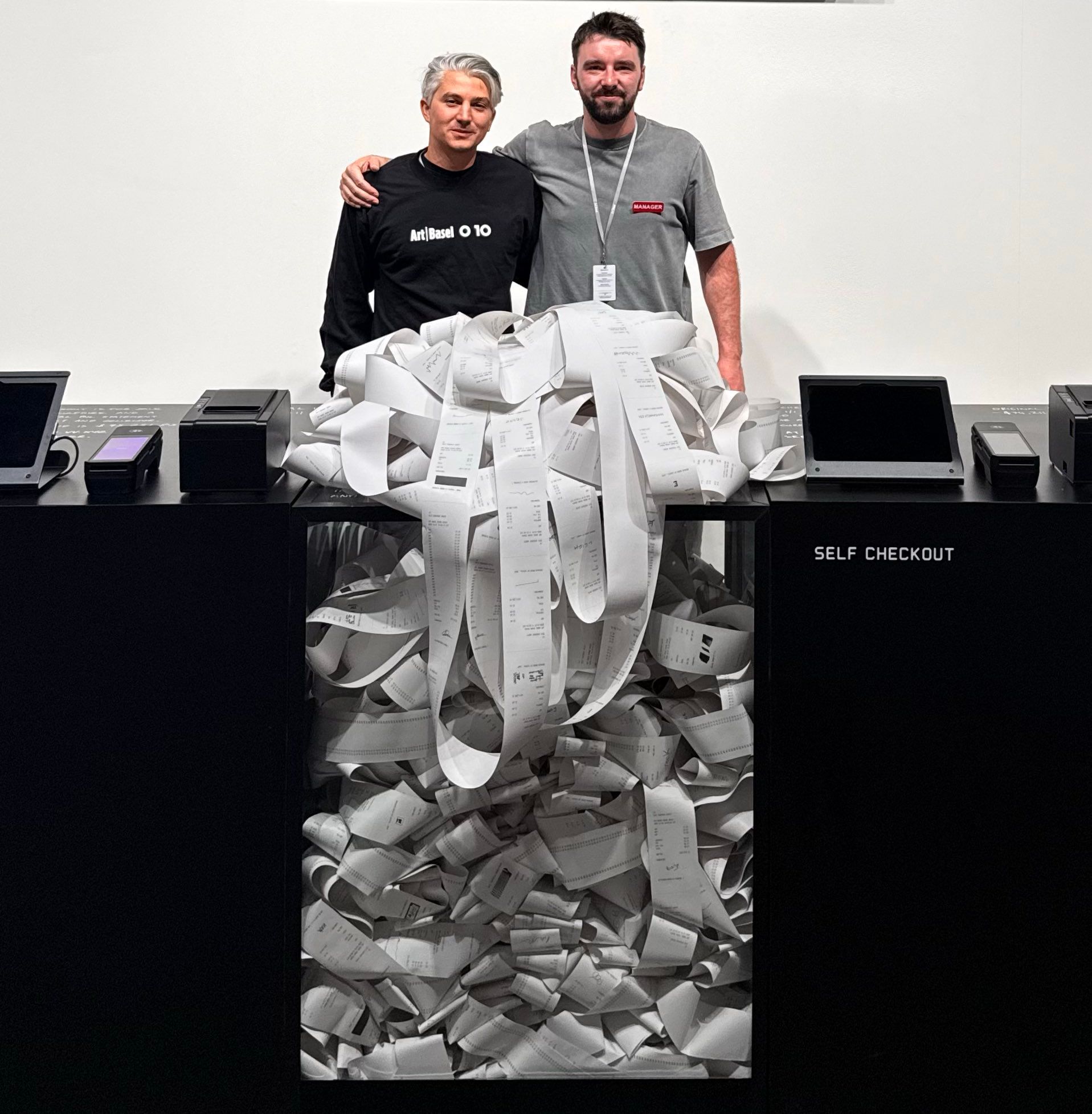
How the number changed throughout the days of the fair? This was the part that made the work so unique inside the fair circuit: visitors could walk up to a ‘kiosk’ (the ‘self checkout’) and pay what they wished – starting at one dollar – for a printed receipt. The receipt then became the artwork. If you paid more, and the receipt grew longer, because each dollar printed as its own line item. Thus, the art object that was collected expanded in literal proportion to each person’s personal decision. For Butcher, who presented this project through his organization Visualize Value, Self Checkout formed a translation of his central theme into a physical and social situation. The theme being: value is not a neutral fact, but something that continuously changes based on new, overall consensus. In the art world, this is often kept backstage.
A receipt of 'Self Checkout'
A receipt, upgraded
In our world, receipts are designed to be discarded. Thermal paper is thin and pale; it curls and the ink fades easily. In many ways, it is the opposite of ‘the archival’. Butcher’s conceptual coup is that he chose a support that our minds have always seen as negligible, and then asked people to treat it as something special and to be held permanently.
Art history has plenty of precedents for this kind of reversal. The readymade is the obvious ancestor: Marcel Duchamp’s proposition that selection can be a form of authorship. But Self Checkout is not simply “a receipt, framed.” It is closer to the conceptual art of the late 1960s and 1970s, when artists tested whether the artwork could be an instruction, a record, a certificate, a contract ie. – something that shifts the attention from the crafted object to the system that produces meaning.
Here, the system is not only ‘institutional’ and the concept of the artwork, but also psychological since it’s not a fixed parameter: a fairgoer’s private choice becomes public form, and the receipt is an index of choice. It proves a transaction, it is the artwork, ánd it materializes a decision. Looking at the lineage of ‘evidence-based’ conceptualism: if the twentieth century made the certificate into a centerpiece, the twenty-first makes the (live) metric the main principle. And Butcher is designing inside this shift.
'Self Checkout' at Art Basel Miami, December 4-7 2025
Art fair, an accounting performance
If you’ve ever spoken to an art dealer during an art fair, you might have seen the fatigue beneath the glamour. Everyone is doing the same mental math: shipping costs, staff hours, dinner obligations, booth fees, networking drinks, the gamble of inventory, and the terror of a slow first day. Tim Schneider framed it sharply: “every dealer is running this calculus internally; Butcher simply externalized it.”
Exactly this ‘move’ punctures an important, underexposed illusion of fairs: that the commercial outcome is secondary to the cultural one. In reality, a fair’s aesthetic is mostly an interface designed to make high-stakes transactions feel frictionless. Self Checkout reintroduces friction not by blocking the sale, but by showing its conditions. Here is real exposure, all out in the open, with the work’s mechanism very straightforward: – retail kiosks at the booth, plus online purchases feeding the same system; – a live profit-and-loss display beginning at the exact cost figure; – a glass container collecting the accumulating paper trail from the online purchases; – the printed receipts contain a seed phrase that links to a digital counterpart (that cannot be resold).
It is, as Butcher’s own project text puts it, “live accounting presented as installation.” For me, the art-world importance here is not just that the piece is transparent, but even more so that it forces the fair’s default mode – curated opacity – to compete with transparency. Whilst most fairs depend on asymmetry – who knows what, who pays what, who gets in first, who hears which rumor at which dinner, Butcher replaces ‘guessing’ and ‘gossip’ with an actual scoreboard, shifting a part of the fair from a theater of discretion to a theater of data.
A receipt of 'Self Checkout'
“Pay what you want”
And then there’s the pricing model, which is where the work is also genuinely ‘strange’ compared to a standard art-fair set-up. “Pay what you want” sounds, at first, maybe a little bit like a populist gesture and only done for something that isn’t really ‘valuable’ (here it is again, the overarching theme of Butcher). But for Butcher, it is a way of abolishing hierarchy, inviting collectors to decide for themselves.
There are many interesting aspects to this objective. First of all it might sound liberating, but it’s also possible that you feel ‘heavy’ because of what the decision is entangled with: a certain ethics towards artists, what you’re signaling, your social proximity, possible embarrassment, desire to be seen as supportive, maybe a fear of looking cheap. So, you could say the kiosk solicits self-definition (and fittingly enough self-validation) through a payment. Also, starting at and showing the number -$74,211, the crowd understands the ask not as abstract support but as debt relief, with the fair booth becoming something close to a public fundraiser. I’m immediately wondering if people would mostly participate to help the artist break-even at least, and would maybe give less if they would see the bar is already met?
Self Checkout did get criticism: Hyperallergic’s Valentina Di Liscia called it a “shameless” instance of crypto-backed art replicating the very wealth mechanisms it claims to subvert. Kevin Buist, a writer for Le Random, actually pressed the question to the artist directly: “What, exactly, is being subverted?” Butcher’s answer was: “Transparency is seen as critique.” And that sentence for me is key because the work does not claim to escape capitalism. It claims that showing capitalism clearly – without varnish – already functions as a kind of critique, because the art world is accustomed to ‘fog’.
Jack Butcher (right) at Art Basel Miami, December 4-7 2025
The digital component
The project’s digital component is carefully designed not to be the main speculative vehicle. Each receipt includes a seed phrase that creates or unlocks a wallet holding the digital copy – an NFT that functions as proof of ownership. Butcher said that the NFT is not meant to be sold; “it exists to authenticate the physical receipt, flipping the usual ‘NFT as receipt’ accusation back on itself.”
This is quite important I feel, because in the last few years the discourse around NFTs has become a certain binary: either they are revolutionary, or they are scams; either they create new ownership, or they create new hype. Self Checkout is way more thoughtful than that. It treats the blockchain as a notary (not as a casino), and makes you aware of something that isn’t spoken of that much: the vulnerability of custody. Thermal paper fades, but seed phrases can also be lost. The immutability of the ledger doesn’t save you from your own negligence. In other words: the work argues that ‘on-chain’ doesn’t automatically mean ‘safe’. It makes permanence into a collaboration between infrastructure, and the actual human tendency to lose things.
Di Liscia’s objection – that the work mirrors the wealth mechanics it gestures at critiquing – is fitting because the piece is not shy about commerce. But that is precisely why the non-transferable NFT matters: it withholds the easiest speculative loop. In that regard, you could see the work’s real target is not buying and selling as such; it’s the ‘myth’ that the infrastructure makes us safe. In Self Checkout, permanence is an agreement you can still fail to uphold. You check out with an amount you choose, and you have the task to keep ahold of your proof of ‘checking out’.
Transparency can still produce scarcity
If you thought we’d be done analyzing this project by now, I’ve got another thing coming for you: abundance doesn’t eliminate scarcity. This might sound strange and I had to think about it for a while also, but here’s my breakdown ↓
The receipts were, in principle, unlimited. Anyone could buy one (also online, so it wasn’t based on the amount of fair visitors). But scarcity here actually reappeared through behavior. Very few people paid the highest amounts and the longest receipts are now rare (by social fact and not by contractual enforcement). Every receipt is an editioned trace of participation, and because the system records everything – the actual amount but also the signature of the collector, the act of support becomes legible. It is easy to imagine why certain collectors or operators would want their names near the top: philanthropy, visibility (since you can back-search for the receipts per amount), patronage, and self-branding, all braided together. All the receipts make that braid visible from many different angels.
And so this is where the work becomes less about ‘transparency’ in a moral sense and more about transparency as a 'medium' – a way to reveal that art valuation is always a mixture of belief and incentive, and then acted on.
Visualizing value; split-flap display at Art Basel Miami, December 4-7 2025
The outcome
This is how the project ended in numbers. According to Butcher’s own published final figures, the installation closed with $188,917.51 in total income and $114,706.51 in closing PNL (profit), after collecting 5,837 receipts, with an average receipt of $11.41. Those totals complete the form, since the work is partly about whether transparency is rewarded. And, at least in this case, it was.
What Butcher brought to Miami was a clean proposition:
– Here is the cost.
– Here is the object.
– Here is the proof.
– Here is the social game you are already playing – now made explicit.
Where art commerce usually tends to happen behind closed doors, an artwork that insists on being literal feels very refreshing. Butcher isn’t at all naïve about money and value (I had to use this word in the last sentence of course), but he also refuses to sentimentalize it.