This December, Silk Road continues in Bangkok. From 9–12 December 2026: four days of exhibitions, talks, performances, screenings, installations, private dinners, and gatherings.
It was during a particular kind of dinner in Singapore, with the table getting loud before the food arrived. It was Chinese New Year 2023, and my partner Ambar (also a co-founder of SILK) and I were sitting with a group of NFT collectors. All enthusiastic, sharp, deeply invested in their communities, and operating at what I can only describe as peak conviction energy. These are the kind of people who don't just follow what's happening in this space; they feel personally responsible for it.
The tradition was yusheng, a Cantonese salad you toss into the air together, as high as possible, for good luck in the year ahead. Twelve of us around the table, noodles flying. The guy next to me was a young collector who prided himself on always being exactly one step ahead of the curve. Mid-toss, he leaned over and started whispering in my ear about an artist I needed to look into. His Singlish at full speed didn't make the explanation easier to follow.
But the name stuck: Jack Butcher.
What he was describing was Checks. And what had caught this crowd's attention, a crowd that had seen everything in NFTs by this point, was that here was an artist generating real momentum during a market heading in only one direction: down.
That's when the intrigue began.
Flipping the script
Every rule in the art world tells you to protect your supply, guard the scarcity, and don't flood the market.
Jack Butcher did the opposite.
Checks launched as an open edition. Anyone could mint for 24 hours for just $8. No cap, no waitlist, no curated collector list. Just over 16,000 pieces minted. By conventional logic, that's a recipe for worthlessness. But what came next is where everything changes.
After the open edition closed, Jack introduced a burn mechanism. Holders could burn two 80-check pieces to create a 40-check piece. Then two 40s into a 20. Then a 10, a 5, a 4, all the way down to a single black check. Only three of those could ever exist, each requiring 4,096 original editions to ‘produce’. I thought the math was brutal and elegant at the same time.
However, what strikes me most about Checks isn't the mechanics, but what those mechanics demanded from the collector. You couldn't be passive – you had to decide. Do I burn? Do I hold? Do I coordinate with others? What am I actually valuing here?
Collectors weren't just thinking about art; they were making decisions that would directly affect what they personally held. Artists have always tried to push viewers to think in a certain direction. Very few have managed to make people act in ways that change their own outcomes, Jack did that from the first project.
The obvious question is then: why this didn’t collapse into pure financial engineering? Because plenty of projects built burn mechanics and participation loops and ended up feeling like derivatives trading with an art wrapper. Checks didn’t, and I think the reason has something to do with the clarity of the underlying question. The mechanism wasn’t obscuring a thesis — it was the thesis. What do you actually value, and what are you willing to destroy to get there? That question had enough philosophical weight to hold the structure up.
Jack Butcher
Starting at zero
If Checks showed what could happen when you gave people agency, Opepen showed what could happen when you started with nothing at all.
Opepen launched as a free mint: Zero dollars; 16,000 wallets; same artwork for everyone. On paper, this was the least valuable thing imaginable.
Then came the announcement: these free tokens were actually tickets. Tickets to participate in 200 unique drops, each revealing 80 Opepens at a time, across edition sizes running from 1/1 down to 1/40. Every drop is preceded by collectors signaling which upcoming artwork they want. If demand doesn't reach the required threshold, usually around 20x the available supply, the drop gets cancelled. To date, every single drop has cleared it. Sometimes by 10,000%.
What started with no monetary value, no scarcity, and no prestige became one of the most closely watched projects in Web3. Not because of hype. But because the structure created genuine stakes. Collectors who held free tokens were now embedded in a system where time, participation, and taste determined outcomes.
The 1/1 Opepens from certain drops now trade at serious multiples. The project is still only partway through its 200-drop arc. Alive and evolving, with guest artists bringing their own visual language into each drop. The kind of project that keeps collectors genuinely engaged across years. That continuity is rare anywhere, let alone in this space.
Four different 'Opepens'
The value ladder
Hermès won't sell you a Birkin the first time you walk in. You have to build a relationship first. So, you establish purchase history, and you earn access over time. The scarf isn't a lesser product, but it's the beginning of a journey that only some people complete.
Louis Vuitton, Chanel, all the great houses operate with some version of this. Accessible entry points, mid-tier objects that build attachment, and at the top, pieces so scarce that acquiring them signals something beyond mere purchasing power: commitment and history with the brand. What Jack has built, I feel, operates on a similar logic, but with one important difference: the hierarchy isn't enforced from above. It emerges from the system itself.
But the mechanism underneath is fundamentally different. Luxury houses control the hierarchy from the center: they decide what gets made, in what quantities, for whom, and when etc. In other words; the scarcity is administered and the access is granted. Therefore, the narrative belongs to the house. In Jack’s system, none of that is true. The hierarchy emerges from the participants themselves. A 40-check piece sits above an 80-check piece because collectors chose to burn their way there. An Opepen 1/1 from a sought-after drop carries weight because thousands of people signaled for it. Nobody at the top decided what was scarce, but the structure made that determination collectively, in public, and in real time.
This is why I feel the comparison to luxury runs deeper than aesthetics or aspiration. Both systems produce tiered value and genuine desire. But one does it through control, and the other does it through transparency. Jack didn’t invent the architecture. He made it legible enough to inhabit. Because the hierarchy is legible and participatory, nobody questions the relative value. You know where you stand. The path upward is open: burn your way there, trade your way there, or participate your way there. Entry-tier builds community, and everything above it builds conviction.
The receipt you want to frame
If I asked you how to turn an object you most likely want to throw away into something you'd frame and keep forever, I'm not sure I'd know where to start.
Jack figured it out, though, and the object I’m talking about is a thermal receipt.
At Art Basel Miami in December 2025, Jack’s installation Self Checkout began with a number on a split-flap display: -$74,211. This was the exact, stated cost of participating in the fair, including booth fee, shipping, fabrication, travel, labor, all of it made public from the first minute. Most artists keep those numbers completely private, but Jack put them on the wall – literally.
Visitors could walk up to a kiosk and pay whatever they wanted, starting from 1$, for a printed receipt. That receipt was the artwork. The more you paid, the longer it got, each dollar printing as its own line item. The project closed with nearly $189,000 in total income and just over 5,800 receipts collected.
Self Checkout 2025
With Self Checkout, the question Jack raised is: which receipt is more valuable – the one that costs a dollar or the one that costs a thousand? The expensive one is rarer, by social fact rather than contractual enforcement. The cheap one is the more democratic gesture. Both are the same object. The value lives entirely in the decision made by the person who bought it, and in what that decision says about them.
The beauty in that for me: Jack doesn't resolve that; he just makes you sit with it.
A bookstore in Europe
About two and a half years after Singapore, I was in a bookstore in Europe and picked up a copy of The Anthology of Balaji by Eric Jorgensen, a collection of ideas by Balaji Srinivasan, illustrated throughout with visuals I recognized immediately: clean, black-and-white, ideas compressed into simple forms. It was the Visualize Value language.
A Visualize Value graphic
I’d been following Jack’s work for years by then, and I’d collected dozens of editions, so I thought I understood what he was doing. But standing there, looking at those images applied to philosophical and economic ideas about the future of money, value, and sovereignty, something landed differently. Not art commenting on ideas — art that was the ideas, indistinguishable from the thinking itself. Few artists are examining these questions from inside the system itself. Jack does. He’s been doing it since the beginning, through every project, in every medium he’s touched. And the longer you follow the work, the more coherent that thread becomes.
Looking at it from a broader perspective, you could say that money and value sit at the center of almost everything humans do. Seven-year-olds on Instagram reels already say their dream is money. We organize our entire lives around value, what we earn, what we hold, and what we aspire to. Jack doesn’t just comment on that. He builds systems that make you actively experience it, question it, and make decisions that affect your personal stake in it. That realization led Ambar and me to London, where we met Jack for the first time, together with Alistair Walker from Asprey Studio in Mayfair. We wanted to understand a project called Work, Jack's first physical sculpture, cast in pure silver. We left having acquired it.
'Work' cast in silver 2024 Courtesy of Asprey Studio
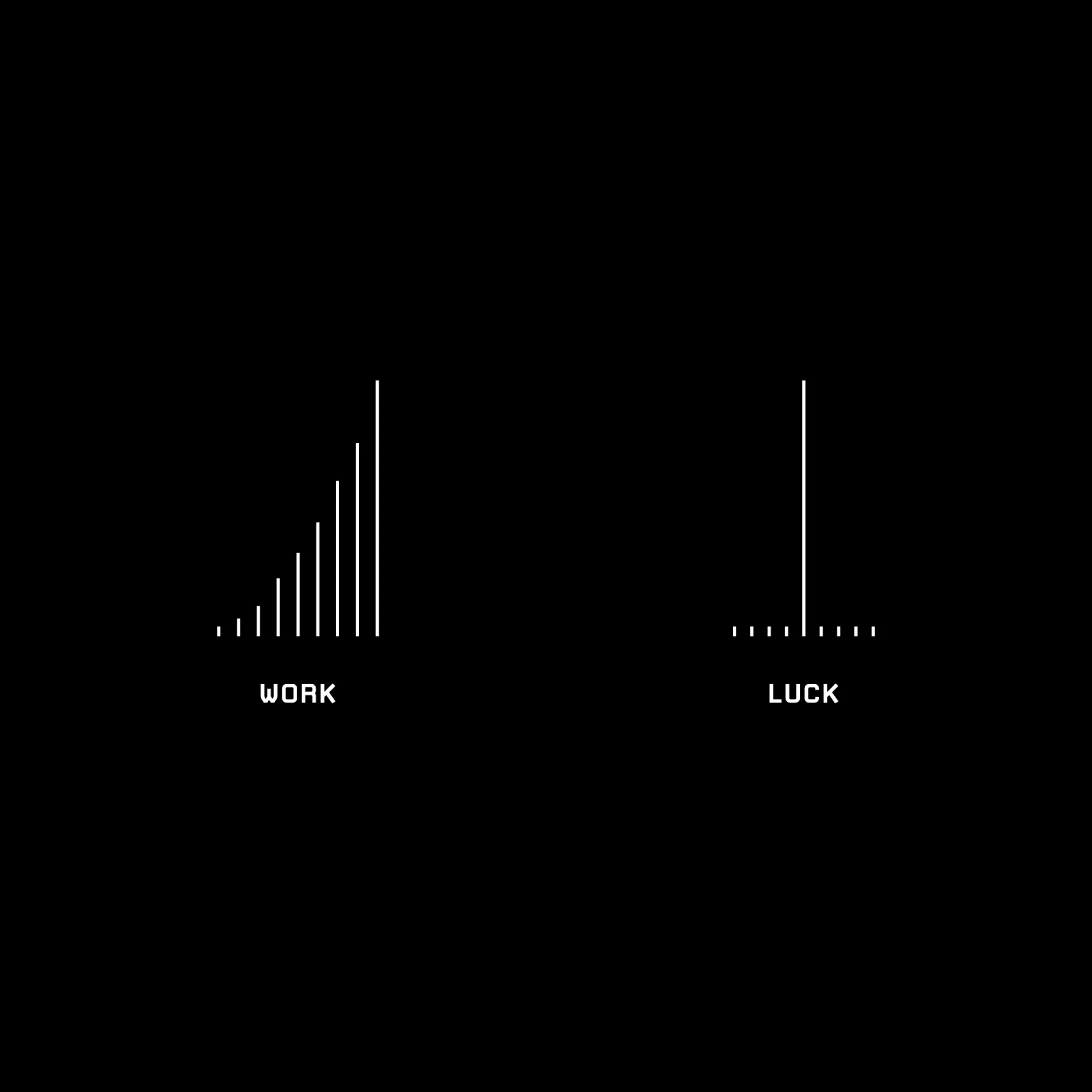
Work, Luck
Work is a four-part silver sculpture tracing the evolution of labour. The first piece is modeled on Michelangelo's David hand: detailed, anatomical, and with the full presence of the made thing. Each subsequent piece becomes more reduced, more mediated, until the final form, a pixelated cursor derived from early Macintosh operating systems.
The click hand, the most reduced and most digital-looking piece, is the one that changed everything in the world. It's the hand that allowed us to scale output beyond anything the artisan's hand could produce. One click can move more value than a lifetime of physical craft ever could. And yet, in a world that has now fully digitalized, the artisan's hand has recovered something: the crafted object, the made thing, the work you can hold, carries a weight that the click cannot replicate. Both are true simultaneously, and Work holds that tension without resolving it.
One detail stayed with me the most: the cursor hand, the simplest and most reduced, was actually the hardest to cast in silver. Four times the labour of the detailed hand. The work that appears most effortless actually required the most effort.
Luck, a new work made for us to show in Hong Kong, completes the pair. It consists of six silver dice, each showing only one face. One die shows only ones, another only twos, and so on, through six. A tool designed for randomness, redesigned into a tool for a predetermined outcome.
At Art Basel Hong Kong, visitors can roll six standard dice for $88. Whatever they roll is what they take home: translucent resin dice matching their exact outcome. The odds of rolling a perfect set in a single throw are about 1.6%. Most people will get duplicates. To complete a set, you either roll again or you find someone willing to trade.
Or, you can buy the silver set for $8,888 – all six outcomes simultaneously, held in a black lacquer container made by Hanoia, the Vietnamese lacquer house. No rolling. No waiting. No coordination required.
"Unless you own the whole system, you are just rolling the dice." – Jack Butcher
That line describes the mechanic and how most people experience the art market. Outcomes are less about effort or luck alone, and more about whether you understand the architecture governing both. Jack doesn't pretend you can escape the system; he just makes it visible enough to navigate.
Jack Butcher
The person
There's still one thing I want to touch upon, which doesn't come through in the work alone.
Jack’s visual language is minimal: every element carries weight, and nothing is decorative. But the person himself operates very differently. When Ambar and I met Jack in London, he was flexible, genuinely curious, and asked as many questions as he answered. The collaboration with Asprey Studio had clearly pushed him into new territory, and he seemed energized by that rather than protective of his previously existing vocabulary.
Staying open while maintaining a clear point of view is rarer than talent. I feel it's what allows him to keep finding new forms for the same essential questions he's been asking since he first started posting black-and-white diagrams on the internet. And it's part of why working with him on this project has felt less like presenting an artist and more like continuing a conversation.
That conversation, and the arc that led to it, from the advertising rooms of New York to Art Basel Hong Kong this March, is also what a soon-to-come short-form documentary by SILK will trace: the story of someone who spent years in systems owned by other people, and then started building them on his own. The work makes that case better than anything else could
‘Work, Luck’ will be on view at Art Basel Hong Kong, March 27–29, 2026.